

Ballet vs Contemporary Dance: How They Differ — and How They Make Each Other Better
19 June 2026
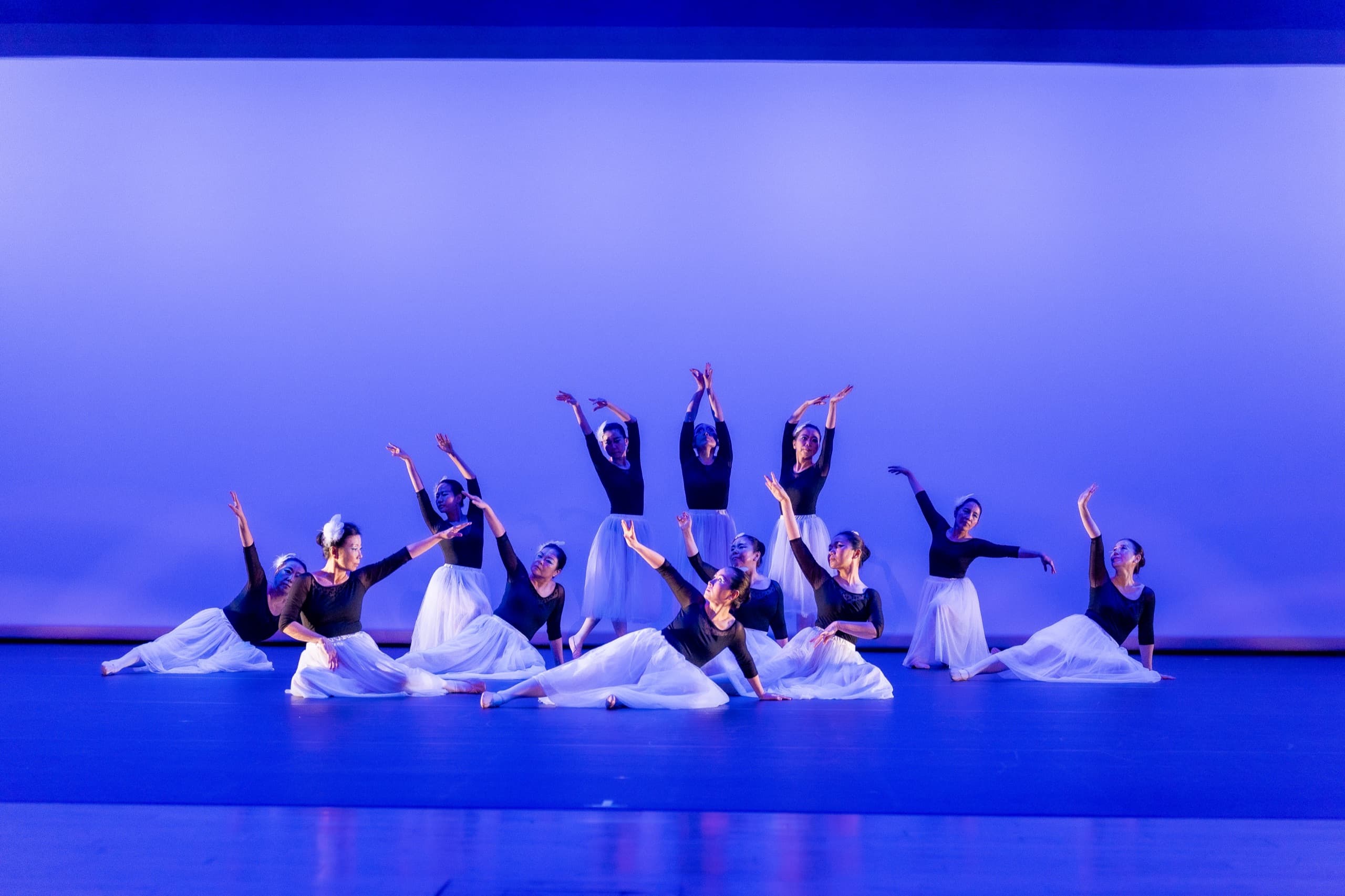
Walk down the corridor of a dance studio on an ordinary weeknight and you can hear the difference before you ever see it. Behind one door there is a hush: the pianist testing a tempo, the soft creak of a wooden barre as a row of adults rise together onto the balls of their feet, chins lifted, spines long. Behind the next door there is a long exhale, the muffled thud of a shoulder meeting the floor and rising again, a body pouring itself downward as though gravity were a companion rather than an enemy. Two rooms, two temperaments — and yet, though it rarely looks that way from the doorway, one longing. Both rooms are full of grown adults trying to answer the same quiet question: how do I move with meaning?
Those two rooms are ballet and contemporary dance. If you are an adult in Singapore standing in that corridor wondering which door is yours, this is a guide to what actually separates the two forms — in history, in the body, in the music, in the feel of a real class — and, just as importantly, why the dancers who fall for one so often end up loving both.
Where they come from
Ballet is the elder by a wide margin. It grew out of the courts of Renaissance Europe centuries ago, then was slowly refined into something remarkable: a codified, named vocabulary — much of it in French — that has been handed down, teacher to student, ever since. When an instructor says plié (a bend of the knees) or tendu (a foot stretching along the floor), a dancer in Singapore and a dancer in Paris picture the same shape. That shared language is ballet's great inheritance. It is the reason a beginner's first class can feel like being handed the opening pages of a very old, very precise book.
Contemporary dance is the younger relative, and in a sense it was born in conversation with ballet. Over the twentieth century, dancers began to push against all that codification — against the idea that there was one correct, upward, idealised way to hold a body. They lowered themselves to the floor. They let a movement begin from a breath or a fall rather than a fixed position. Rather than a single fixed syllabus, contemporary draws on many streams of modern technique, which is part of why it can look so different from one choreographer to the next.
What each was trying to say
Underneath the steps, each form carries a different wish. Ballet reaches for order and an idealised line — beauty as something composed, elevated, a little more perfect than daily life. Contemporary reaches for honesty and human weight — beauty as something true, including the parts of us that stumble, lean, and give in to gravity. Neither wish is better than the other. They are simply two answers to the same longing, and knowing which one stirs you is the first clue to where you might begin.
How they move
The clearest difference lives in the body itself.
Ballet organises everything around verticality and lift. Dancers work with turnout — the legs rotating outward from the hips — and a constant sense of "pulling up," as if a thread ran from the crown of the head to the ceiling. Feet point, positions are precise, and control is prized: the goal is a clean, unbroken line that looks effortless precisely because it is so disciplined.
Contemporary organises everything around release and flow. Instead of resisting the ground, dancers use it — this is floorwork, moving on and with the floor: rolling, sliding, rising from a crouch. Movement often begins with the breath and travels through the body in spirals; partners lean on and catch one another in weight-sharing. Where ballet asks you to hold, contemporary asks you to let go and then recover.
Gravity is the giveaway
If you ever want to name what you are watching, watch the relationship to gravity. Ballet defies it — everything strains upward, lightening the body until it seems to float. Contemporary befriends it — the dancer surrenders into the floor and borrows its pull to launch the next move. One reaches up; the other reaches out and down. Once you see that, you will never un-see it.
How they sound
The music tells you almost as much as the movement. Ballet has long married itself to classical scores, with a clear meter and phrasing that maps neatly onto steps — the count of the music and the count of the choreography move as one. Contemporary is far more restless about sound: a piece might unfold in near silence, over spoken word, or against layered electronic textures. Its phrasing tends to follow intention rather than counts, so a movement lasts as long as the feeling behind it needs to last. For a beginner this is a genuine difference in experience — ballet gives you the reassurance of structure to hold onto; contemporary gives you the freedom to shape time yourself.
What a class actually feels like
Both forms begin, for an adult, from exactly zero — and both build in a shape you will quickly come to trust.
A ballet class tends to be a ritual. You start at the barre, using it lightly for balance while you warm the feet, knees, and hips through familiar sequences. You move to the centre to find those same shapes without support, then travel across the floor. There is repetition and there is alignment, and there is a deep, almost meditative satisfaction in returning to the same exercises and feeling them grow cleaner week by week.
A contemporary class tends to be an exploration. It often opens with a release-based warm-up to loosen the spine and find the breath, moves into improvisation or short phrases of set choreography, and builds toward travelling sequences across the room. You are given permission to interpret, to make a movement your own. It can feel less like being corrected and more like being invited.
At YUE, our teachers often reassure nervous first-timers of the same thing:
You are not behind. Every experienced dancer in this room once stood exactly where you are standing, learning to trust a body that felt like a stranger.
Ballet and contemporary, side by side
If you like your differences in one glance, here they are:
| Ballet | Contemporary | |
|---|---|---|
| Relationship to gravity | Defies it — lifts and lightens | Befriends it — grounds and releases |
| Vocabulary | Codified, named, centuries old | Fluid, drawn from many modern techniques |
| Feeling | Order, line, composed elegance | Honesty, weight, emotional openness |
| Music | Often classical, clear meter | Silence to spoken word to electronic; intention over counts |
| Best first taste for… | Those who love structure and a clear "right way" | Those who love freedom and room to interpret |
Why they make each other better
Here is the part that surprises people, and it is the heart of the matter: ballet and contemporary are not rivals. They train different halves of the same instrument, and each one quietly repairs what the other can leave underdeveloped.
Ballet's discipline sharpens contemporary. The dancer who has spent time at the barre brings cleaner lines to the floor, a stronger core, quieter landings, and a spatial precision that makes even the most abstract movement legible. Control, it turns out, is what lets freedom read as intentional rather than accidental.
Contemporary's release loosens ballet. The dancer who has learned to move from the breath brings a musicality and an emotional openness back to classical work — softer arms, a less rigid spine, a face that finally tells the story instead of merely holding the pose. Letting go, it turns out, is what keeps precision from hardening into stiffness.
This is exactly why serious dancers rarely pick one side forever, and why a studio that lives under one roof can teach the lesson better than a single-style school. YUE teaches Chinese dance, ballet, contemporary, and folk in the same set of rooms — cross-training is not a slogan here but the daily reality. Our adult ballet is led by Shen Zhihua (沈芷华), a graduate of the Shanghai Dance School with a professional ballet career behind her; contemporary is led by our artistic director Daniel Deng Yu (邓宇), who trained under the modern-dance master Cao Chengyuan. You can read more about the people who would actually teach you on our instructors page. Between them, the studio's work has reached stages from the Chingay Parade to our own anniversary recital, YUE Dance Rising (悦舞飞扬) — mentioned not as a boast, but as reassurance that beginners here are guided by dancers who have stood in the light themselves.
Which one suits you right now?
You do not need to decide forever. You only need to decide where to begin. A few honest questions usually point the way:
- Do you crave structure, or do you crave freedom? A clear system to master, or open space to explore?
- Would you rather learn a clear "right way" first, or have room to interpret from day one?
- Are you drawn to building precision — lines, balance, control — or to releasing tension — breath, weight, letting go?
- When you imagine dancing, do you picture yourself lifting up and out of the everyday, or sinking into something honest and grounded?
If you lean toward the first answer in each pair, start at the barre. If you lean toward the second, start on the floor. And if you genuinely cannot tell — good. That may be the most useful answer of all, because it means the only real way to know is to feel both in your own body.
Try both, then choose — or don't
The truth most dancers arrive at eventually is that the beauty lives in the contrast. Ballet teaches you to reach; contemporary teaches you to release; between the two, you learn the full range of what a body can say. There is no wrong door here, and no door that locks behind you.
So sample both. Curious which one speaks to you? Any class is $38 for a 1.5-hour session — try the barre one week and the floor the next, and let your own body cast the deciding vote. Browse the timetable on our schedule, then get in touch to book your first class. Whichever room you step into, you will be in good company — and you may well find, as so many of our adult students do, that the answer was never one or the other.
Come find the beauty in dance
Any class, $38 for a 1.5-hour session. Come see how it feels.
Book a Trial