

Chinese Dance as Living Heritage in Singapore
5 June 2026
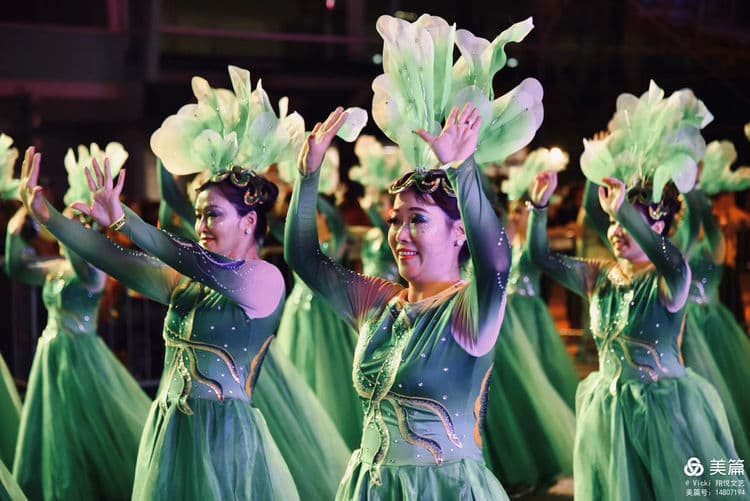
On a Chingay night, the street becomes a river of light. Drums roll up from somewhere deep in the crowd, ribbons unfurl like brushstrokes across the dark, and silk fans open all at once, catching the stage light before folding shut again. Around you stands the whole of Singapore — every language, every background, phones raised, children on shoulders. Then the camera of your attention narrows, past the spectacle, down to a single dancer: the lift of a chin, one long breath held at the top of a turn, the small honest effort in the shoulders. Here is the quiet truth behind the pageantry. That dancer is not a relic of some distant court. She is an ordinary adult who rehearsed for months after work. Chinese dance in Singapore is not a museum piece. It is living heritage — carried forward by adults, in public life, right now.
What "living heritage" really means
Heritage is easy to picture as something kept behind glass — preserved, admired, untouched. But the more honest word for what happens on a festival stage is practice. Heritage that lives is heritage that someone chooses to do: to rehearse, to sweat, to get a gesture slightly wrong and try it again the following week. It is passed hand to hand and body to body, not simply inherited by being born into a name.
Chinese dance is not one thing but a family of related forms, and it helps to hold them apart gently. Classical dance (古典舞) is built on line, breath, and 身韵 — the "body rhythm" that ties movement to the pull and release of the breath, so that even stillness feels alive. Folk and ethnic dance (民族舞) carries the character of specific regions and peoples across China — the bounce of one, the ribbon-work of another, the earthy weight of a third. Above both sits the broad umbrella of 华族舞, Chinese dance in the widest sense.
What makes Singapore particular is that these forms did not simply arrive intact and frozen. They were carried here, taught here, re-choreographed here — and over decades they grew a diasporic voice of their own, shaped by this island rather than merely imported to it. That voice takes its place alongside Malay, Indian, and many other art forms that share the same civic stages. Chinese dance here is one thread in a much larger weave, and it is more beautiful for being one thread among many.
The festival calendar: where the culture becomes visible
For most of the year, this tradition lives quietly — in studios, in community centres, in the hour between the end of the workday and the last train home. But the calendar has its openings, moments when the culture steps into the street and becomes visible to everyone.
Chinese New Year is the great one. At River Hong Bao (新春河畔嘉年华), one of Singapore's most beloved Lunar New Year festivals, dance becomes a seasonal ritual and a very public kind of joy — a way of marking the turning of the year with the whole city looking on. And at 妆艺大游行, the Chingay Parade, communities share the same road on the same night: Malay, Indian, Chinese, and more, each bringing its own colour to a single moving celebration. Chingay is the perfect picture of the thing itself — Chinese dance as one voice in a chorus, never the whole song.
We have had the privilege of standing on both of these stages. At River Hong Bao our dancers were recognised with a Best Live Performance Award, carrying pieces like 《傣家竹雨情》 and 《阿里情》 onto that riverside stage. At Chingay, a team of thirty-five took to the parade — a performance that was later featured by The Straits Times and shared by PM Lee Hsien Loong. We mention these less as trophies than as evidence of participation: proof that this is a shared civic ritual we are lucky to join, not something we own or represent. The applause on those nights belongs to the festival, and to a country that makes room for many traditions at once.
What the movement carries
Watch closely and you begin to read the dance the way you read handwriting. A silk fan is not decoration; it extends the arm and turns a wrist-flick into a wave that travels the length of the body. Long ribbons draw shapes that hang in the air a half-second after the dancer has moved on. Water sleeves (水袖) — those long trailing cuffs — let grief, longing, or delight be thrown, gathered, and let go, so that a feeling becomes something you can literally see cross the stage.
Underneath these props sits an aesthetic that classical Chinese dance shares with much of Chinese art: a love of roundness over sharp angles, of restraint over display, of the breath that fills a movement from the inside. A turn is rarely just a turn; it curves, hesitates, and resolves. None of this needs to be mystified to be admired. It is simply a grammar — a way of shaping the body so that gesture carries emotion and, sometimes, story. You do not need to know the vocabulary to feel it land. That is the point of a language that lives: it speaks even to those still learning to read it.
Community and belonging: a place to stand
For an adult, joining a dance troupe is rarely only about the dancing. A studio becomes a chosen community — a place to stand among people who share a rhythm. For many Chinese-Singaporeans it is also a thread back to identity, a way of staying in conversation with a culture that might otherwise live only in food and half-remembered festivals. For others it is intergenerational: the reason a grandmother's music suddenly means something in your own body.
That belonging shows itself on stages that have nothing to do with competition — cultural galas, charity concerts, community celebrations where the point is simply to give. Our dancers have performed at the Singapore Chinese Spring Festival Gala and in charity concerts alongside guest artists, and each year they gather for our own recital, 《悦舞飞扬》 (YUE Dance Rising). These are not showcases of individual talent so much as occasions to belong to something in public.
And belonging here is not fenced off by heritage. Non-Chinese adults are welcome on the same floor, and the tradition is generous enough to hold them — because a living culture grows precisely by being shared, not guarded.
Keeping Chinese dance alive — and moving it forward
Here is the part that surprises people: to keep a tradition alive is also, quietly, to change it. "Living" means moving. Each generation of dancers adds a layer, and today's adult learners honour the old forms while bringing something of their own moment to them.
You see it in how they train. A dancer might cross-train in ballet to sharpen line and turnout, or in contemporary dance to loosen the spine and find new ways to fall and recover — then carry that back into a classical piece, where it reads as freshness rather than rupture. New choreography borrows the old grammar to say something contemporary. This is how our Artistic Director, Daniel Deng Yu, and instructors such as Chang Hsiao-Min, Bai Ying Wen, and Angel Peng carry the work forward — not as curators of a fixed past, but as artists still making. Each year's recital is, in its own small way, another layer added to the tradition: proof that heritage is not finished, and never was.
Beginning your own thread
None of this requires a childhood in a dance school or a family line of performers. It does not require Chinese heritage at all. The dancers you admired on that festival street began, most of them, as adults — some as complete beginners, some returning after decades away, all of them starting from where they stood.
That is the honest invitation of a living tradition: it is still open. There is always room for one more body in the line, one more person willing to hold the breath at the top of the turn.
So if any of this stirs something in you, come stand on the floor with us. A single trial class — any class, $38 for a 1.5-hour session — is a gentle way to feel the tradition from the inside rather than from the crowd. Meet the people who carry the work, find a time that fits your week on our schedule, and when you're ready, say hello. Heritage is something you do. Come do a little of it with us.
Come find the beauty in dance
Any class, $38 for a 1.5-hour session. Come see how it feels.
Book a Trial