

Chinese Dance vs Folk vs Classical: What's the Difference?
12 June 2026
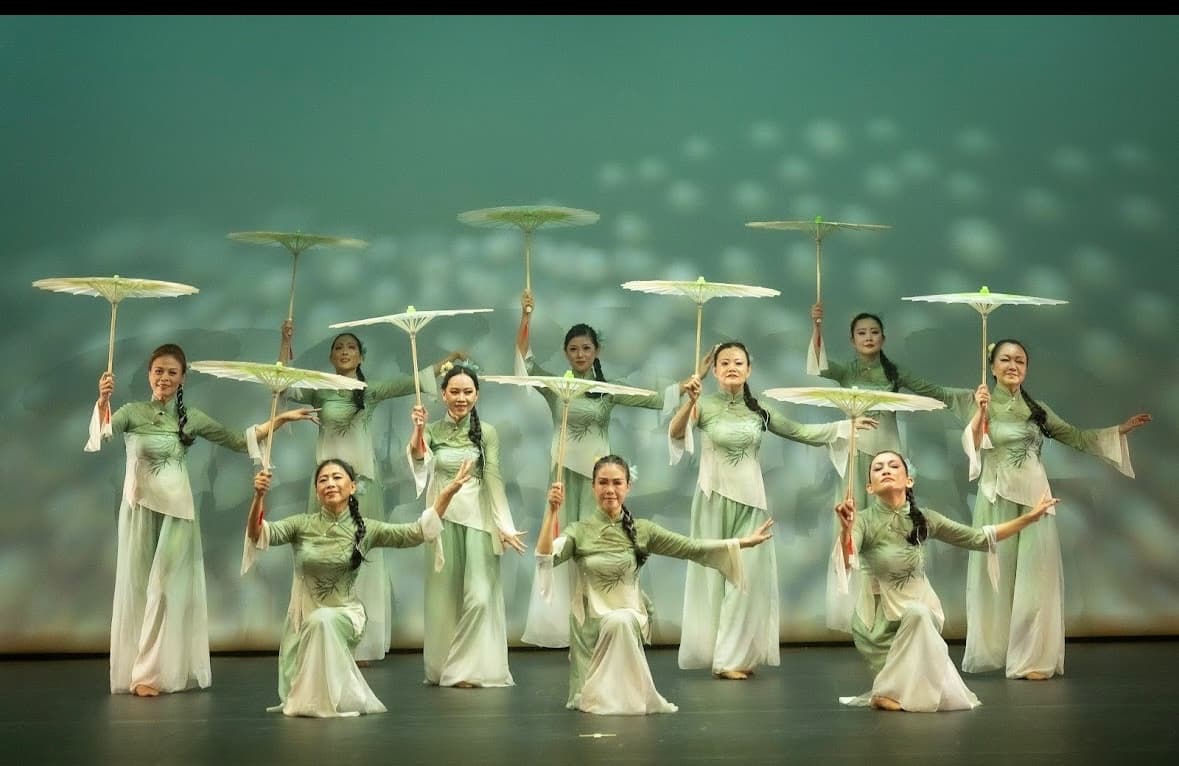
"Teacher — Chinese dance, folk dance, classical dance… what's the actual difference? Which one should I sign up for?"
Some version of that question reaches our front desk almost every month. The person asking is usually standing in front of the schedule, full of longing and a little dizzy from the terms. It isn't your fault. In Singapore's Chinese community these words get used interchangeably — the media, community groups, even class brochures don't always agree.
So let's untangle the tree, branch by branch. By the end of this piece you'll not only be able to tell the three apart — you'll have a good idea which one to try first.
Here's the one-line answer: these aren't three rival categories. They're branches of the same tree. Chinese dance is the trunk — the umbrella. Folk dance and classical dance are the two big branches growing out of it.
The biggest misconception: Chinese dance is an umbrella, not one style
Many people picture Chinese dance as a third style sitting beside folk and classical. It isn't.
In Singapore, Chinese dance (华族舞) is usually an umbrella term for the whole family of dance tied to Chinese culture. It covers the serene classical tradition, the colourful ethnic folk traditions, and newer contemporary Chinese choreography. So when you see "Chinese Dance" on a sign-up form, you aren't choosing one specific dance — you're choosing a whole category.
The usage is local. In mainland China, teachers more often say "Chinese dance (中国舞)" or "Chinese ethnic and folk dance," with slightly different emphasis. That's why the same routine might be called 华族舞 by one person and 中国舞 by another — and why everyone ends up confused.
With that cleared up, we just follow the trunk to its two thickest branches: folk and classical.
Folk dance: the dance of life from many peoples
If Chinese dance is the trunk, folk dance is its liveliest branch.
Its fuller name is ethnic folk dance, and its home isn't the theatre — it's daily life. China recognises 56 ethnic groups, and each one's festivals, harvests, weddings and rituals grew a movement language of its own. Geography and culture shape the style. A few you'll meet on local stages:
- Dai dance flows like water, the arms tracing a peacock's neck and beak. The stage favourite 《傣家竹雨情》 comes from this family.
- Tibetan dance rides on a soft knee tremble, long sleeves sweeping the open plateau.
- Mongolian dance has crisp shoulder shakes and a rider's bearing — unmistakably of the grasslands.
- Uyghur dance loves spins and the sliding neck, the head gliding side to side above bright, proud eyes.
A common question: what separates folk dance from ethnic dance? Roughly, folk dance is closer to the raw, self-entertaining form, while ethnic dance is that same material refined for the stage. Day to day the two are simply lumped together. What ties it all is what teachers call signature movement — the handful of gestures that carry each people's flavour.
Folk dance blooms outward. It's warm, expressive, rich in regional colour, and made for group dancing — a room of people spinning, stamping and sweeping their sleeves on one beat is genuinely infectious. For adults the barrier to entry is friendly: strong rhythm, clear beats, quick wins. Even a complete beginner can look the part within a few lessons.
At YUE, folk dance is led by Bai Ying Wen, a graduate of the Folk Dance Department at the Beijing Dance Academy who once helped the celebrated Jia Zuoguang found China's first private dance school, and who has taught at NAFA and the School of the Arts (SOTA). His classes are full of laughter — and of stories about the culture behind every step.
Classical dance: the body rhythm drawn from opera and martial arts
If folk dance is a flower opening outward, classical dance is water drawing inward.
First, a myth to retire: classical here does not mean a dance handed down unchanged from ancient times. Chinese classical dance is actually a fairly young discipline. It took shape across the 20th century by distilling the postures of Chinese opera and the flow of martial arts, then borrowing ballet's systematic training. Ancient in spirit, modern in method.
Its soul is one idea: shen yun (身韵), or body rhythm. Shen yun is to classical dance what breath is to singing — invisible, but it decides everything. It works through rise and fall, advance and retreat, the curve and twist of the torso. In plain terms, it isn't enough to get the shape "right"; the movement has to grow from a breath deep in the core, so that form carries spirit.
You've seen its images: the arc of a water sleeve, the poise of a sword dance, the play of a fan. There are schools within it too — Dunhuang dance drawn from cave murals, Han-Tang dance reviving an older courtly bearing.
Classical dance gathers inward. It's restrained and understated, the energy moving slowly through the body. For adults it's the slower burn: heavy on control and inner breath, less instantly gratifying than folk — but few things do more for your poise, posture and quiet composure. Many students find that, somewhere along the way, even the way they walk has changed.
Our classical classes are led by Angel Peng, a graduate of the Dance Department at Shenyang Music Conservatory with over a decade of teaching. Her guidance is gentle and focused — exactly what shen yun, a patient craft, asks for.
One table for the three (quick reference)
| Dimension | Chinese dance (umbrella) | Folk dance | Classical dance |
|---|---|---|---|
| Level | The trunk / category | A branch | A branch |
| Origin | All dance under Chinese culture | Festivals, work and life of many peoples | 20th-century opera and martial arts, plus ballet training |
| Aesthetic | All-embracing | Warm, outward, regional | Restrained, inward, flowing |
| Signatures | Contains both | Peacock arms, sleeves, shoulders, spins | Shen yun, water sleeves, sword dance |
| For adults | Easiest way to sample | Fast rhythm, quick wins | Slow burn, great for poise |
In a line: folk dance blooms outward, classical dance gathers inward, and Chinese dance holds them both.
What about ballet and contemporary?
Not part of the family — but often next-door neighbours. Ballet is a European court tradition; contemporary is a modern, 20th-century language. Neither sits under the Chinese-dance umbrella. Yet in an adult studio they feed one another: ballet sharpens the lines classical dance loves, and contemporary loosens the body for freer expression. See how they sit side by side on our course overview.
As an adult, where should I start?
Back to that student at the front desk. Which one?
There's no single right answer — only the one closest to where you are right now:
- Want energy, culture and simply to move? Start with folk dance. The wins come fast — ideal for a desk-bound professional who needs to shake off the week.
- Want poise and fine control, and don't mind a slow climb? Choose classical dance. What it teaches is composure from the inside out.
- Not sure, or drawn to both? Take a general Chinese dance class and let your body decide.
Whatever you pick, put down the worries — "am I too late," "I've never danced." YUE is an adults-only studio: working professionals, first-timers, and dancers returning after decades all train here. Age was never the barrier; starting is the only thing that counts. Browse the weekly schedule, or read a few student voices.
Find the beauty in life through dance
In the end, these labels are just doorways. Which one you push open matters less than what waits inside — the dance that finally moves at the pace of your own heart.
Since 2018, our teachers and students have shared the stage at the Golden Lion Awards, the Chingay Parade and the River Hong Bao festival, where the studio won a Best Live Performance Award for 《傣家竹雨情》, 《藏音》 and 《阿里情》. Behind those performances is a room of adults who all began exactly where you are: which one should I sign up for?
You've sorted the categories. Now feel the difference for yourself. Take any Chinese, folk or classical class — $38 for a 1.5-hour session — and let your body choose. Book your first lesson; we're at 47 Beach Road.
Come find the beauty in dance
Any class, $38 for a 1.5-hour session. Come see how it feels.
Book a Trial