

From First Trial to the Recital Stage: An Adult's Path
6 March 2026
Imagine standing on the five-foot-way outside 47 Beach Road on a weekday evening, one hand resting on the studio door, quietly telling yourself you could still turn around. You have wanted this for a long time — longer than you would admit to most people. The music inside is faint. Your work bag is heavy on one shoulder, your head still full of the day. And yet you booked the trial, you set aside your thirty-eight dollars, and here you are.
This is where almost every adult dance journey at YUE begins. Not with talent, not with certainty, not with a lifetime of training — but with one nervous evening and the small, brave decision to walk in anyway. No two of our students arrive by the same road. Some danced as teenagers and let it lapse for twenty years. Some have never taken a single class. Some come straight from the office, still in spreadsheet brain; others come the year they finally decide their own joy is worth an evening a week. But the shape of what follows — from a first trial to, for those who want it, the recital stage — is an arc many of them come to share. Let us walk through it together.
The first trial: one class, ninety minutes, thirty-eight dollars
The trial is deliberately small. Any class you like, $38 for a 1.5-hour session — enough time to feel the room, not so much commitment that fear can talk you out of it.
Here is what those ninety minutes tend to feel like. The first ten are the hardest, and they are almost entirely in your head. You find a spot near the back. You catch your own eyes in the mirror and look away. The teacher greets you by name, shows you where to stand, and — this is the part first-timers rarely expect — nobody is watching you. Everyone else is busy with their own shoulders, their own count, their own reflection.
Then the warm-up begins, and something quiet happens in the body. The breath drops lower. The jaw unclenches. By the time you are moving through a simple phrase — perhaps the soft curve of an arm in Chinese classical dance, or the first positions of ballet — the office has gone strangely far away. You will not be good yet. That is not the point. The point is the moment, somewhere around minute sixty, when you realise your mind has been empty of everything except the music and the count, and that this emptiness feels like rest.
Most adults leave the first class a little flushed, a little clumsy, and noticeably lighter than they walked in. You can browse the full range of styles — classical 古典舞, folk and ethnic 民族舞, ballet, contemporary — and pick the trial that pulls at you, then find a weeknight or weekend slot that fits a working life on the class schedule.
Settling in: your first term
If the trial is a single breath, the first term is where you learn to breathe in time.
The change here is gradual and mostly invisible from the outside — which is exactly why it is so satisfying to feel from within. In the first few weeks, the choreography is a series of separate instructions your brain scrambles to hold: right foot, arm up, turn the head, breathe. Then, without any single dramatic evening, the instructions begin to fuse. A phrase you fumbled in week two becomes something your body simply knows in week seven. You stop counting out loud in your head and start listening to the music instead. This is the moment many adults describe as the point of no return — not because it is hard, but because it feels so good they cannot imagine giving it up.
The physical shifts arrive on their own timetable. Tight shoulders soften. Balance steadies. You reach for a shelf one morning and notice your back is longer than it used to be. None of this is a medical promise; it is simply what tends to happen when an adult body is asked, kindly and regularly, to move well. Alongside it comes something less easy to name — the particular calm of one hour a week when the phone is in the bag and the only task is to be present.
By now you are a regular. You have a spot. You know the names of the two people who always arrive early. Our instructors teach adults specifically, pacing classes for bodies that sit at desks all day and learn best when they understand the why behind a movement. If you want to hear how this feels in other people's words rather than ours, our students describe it in their own voices. A first term rarely ends with you thinking "I've learned a dance." It ends with you thinking, quietly, "I'm a person who dances now." That shift — from doing dance to being a dancer — is the real milestone in any adult dance journey.
The invitation you did not expect: 悦舞飞扬
Somewhere into your second or third term, a new word starts drifting through the studio: the recital.
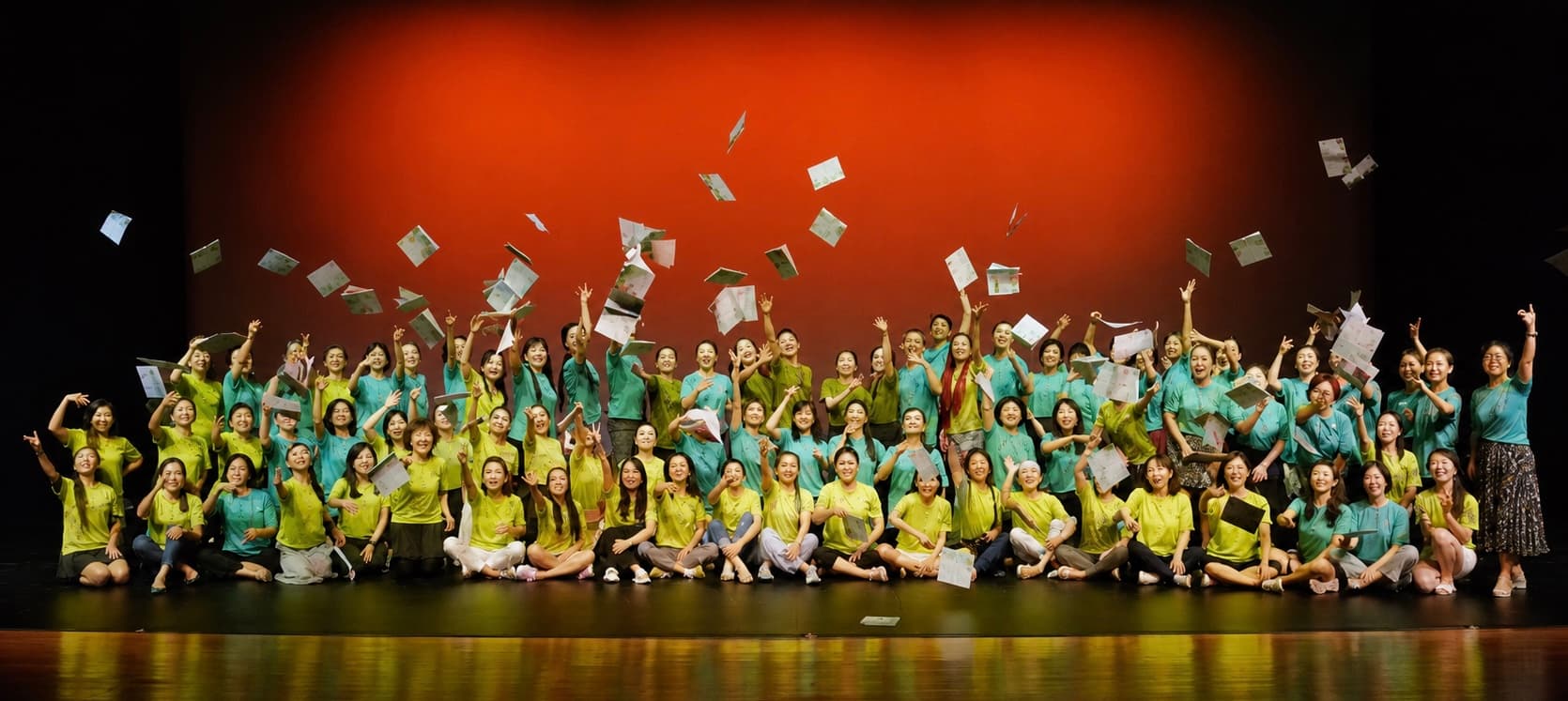
YUE marks its milestone anniversaries with a showcase concert — 《悦舞飞扬》 (YUE Dance Rising), a celebration of the studio's years of artistry, community, and growth. The most recent edition, YUE Dance Rising II, was our 7th Anniversary recital; the first, YUE Dance Rising I, marked five years. It is not the only stage our community has known — over the years YUE dancers have performed at the Chingay Parade, taken a Best Live Performance Award at River Hong Bao, and shared the stage at charity concerts and cultural galas. You can see the full record of performances. But the anniversary recital is the one that belongs to everyone: the evening the whole studio gathers under real lights to show what a year of Tuesdays and Saturdays has quietly built.
For an adult who started, not long ago, standing terrified on the five-foot-way, the recital is a strange and wonderful proposition. Nobody makes you do it. Let us be clear about that: performing is entirely optional. Many of our adult students dance for years and never once step onto a stage, and they lose nothing for it — the studio is theirs whether or not they perform. The recital is an open door, not a requirement.
But some adults, to their own great surprise, find themselves wanting to walk through it.
Choosing the stage — or not
If you do say yes, the weeks before the recital are their own small season. Rehearsals grow a little longer. A costume appears. The phrase you have run a hundred times now has to hold together under lights, in front of people who love you. There is nervousness — the good kind, the kind that means something matters. Backstage, adults who barely knew each other a year ago fix each other's sleeves and whisper counts. This is the transformation the stage offers: not that you become a professional, but that you prove to yourself, in front of witnesses, that the person who once hesitated at the door has become someone who steps into the light on purpose.
And then it is over in four minutes, and you are shaking and grinning in the wings, and something inside you has quietly, permanently changed. Adults who perform in 悦舞飞扬 often say the same thing afterwards: not "I nailed it," but "I did not know I still had that in me." That is the arc from beginner to performing in its truest form — less about polish, more about self-recognition.
If you choose not to perform, none of this is lost to you. You still get the class, the calm, the community, the slow reshaping of a body and a week. The stage is one possible destination on this road, held out for the evening you feel ready — and just as valid to admire from the audience, cheering for the friends you made along the way.
Your evening on the five-foot-way
Every adult dance recital in Singapore that has ever moved an audience began, for someone in it, as a single nervous trial class. The dancer who takes the 悦舞飞扬 stage in a few years' time might be standing outside 47 Beach Road this very week, work bag on one shoulder, one hand on the door, wondering whether to turn around.
You do not have to decide about recitals, or terms, or stages tonight. You only have to decide about one class — any style, $38 for 1.5 hours — and let the rest of the journey introduce itself in its own time. Come and find the beauty in one evening of dance; the door opens more easily than you think.
Book your trial class — any style, $38 for 1.5 hours. Or write to us with a question first; we would love to help you take the first step. If you are still wondering about the practical details, the FAQ covers the small things beginners ask most.
Come find the beauty in dance
Any class, $38 for a 1.5-hour session. Come see how it feels.
Book a Trial