

身韵 & Breath: The Mind-Body Practice of Chinese Classical Dance
20 March 2026
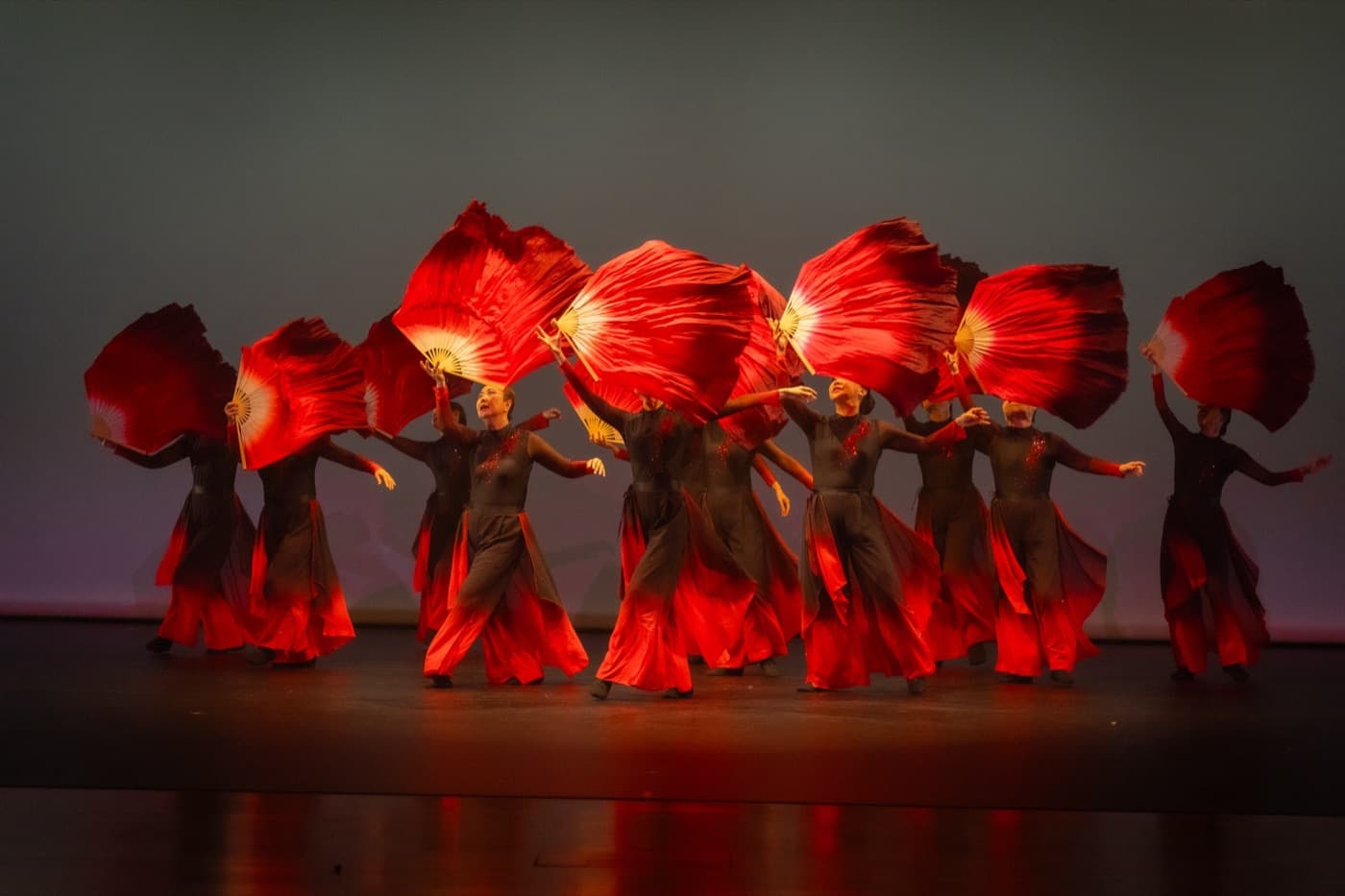
The lights dim, but the music hasn't started yet. Your teacher doesn't rush to teach steps. Instead, she asks you to rest a hand lightly on your lower belly, close your eyes, and take one slow breath in — feeling it settle downward as your shoulders release. Then, on a long exhale, your arm rises along an invisible curve: wrist leading, elbow following, fingertips drawing a soft line through the air. There is no formal "step" yet, and already you are dancing.
For many adults, this is the most unexpected moment of a first Chinese classical dance class. We assume learning to dance means learning a sequence of movements — filing choreography into the body one phrase at a time. But the real starting point of 古典舞 isn't in the feet. It's in the breath. Before it is a dance, it is a mind-body practice.
A mind-body practice first, choreography second
Treat Chinese classical dance as merely "pretty choreography" and you miss its heart. What makes a movement come alive isn't where the hands and feet land — it's two things you can't see:
- 身韵 (body rhythm): the body's inner cadence, the continuous flow that runs between one movement and the next.
- 气息 (breath): the source from which every movement gathers its power and settles.
In ballet, you're first asked to stand tall, turn out, point the foot. In classical dance, the teacher usually begins with breath — with learning to initiate movement from the body's centre. The shape is the result, not the origin. This is exactly why the form is so welcoming to adults: it was never a contest over who can lift a leg higher or spin more, but over whether you can draw your attention back into the body and let each breath be felt.
身韵: the body's inner rhythm
Break the term apart and 身韵 is 身法 (how the body moves) plus 韵律 (inner rhythm). The method is the fine grammar of weight and direction — rising and sinking, leaning, gathering in and opening out. The rhythm is the flow that threads through it all: hard to define, instantly felt. With 身韵, a still shape becomes a breathing line. Without it, even a technically correct pose is just a pose.
There's one crucial feature: movement grows from the centre outward. Classical dance works from the core and the waist — power gathers first at the centre, then travels out through the back, the arm, the wrist, the fingertips. You don't simply "raise an arm"; you let a single breath set out from the core, pass through the spine, and only then scatter at the fingertips. This inside-out, joint-by-joint way of moving trains coordination and awareness at once. You have to mind the breath, the weight, the spine and the extremities together — and your attention naturally collects into the present moment.
None of this is learned in a single class. 身韵 is fed to the body gradually; nobody expects it on day one. It's precisely that slow, growing process that so many adults find grounding.
Breath is the engine
If 身韵 is the language of classical dance, breath is what drives it.
One of the most basic ideas is 提沉 — "lift and sink." On the inhale, the breath lifts and the body opens and rises; on the exhale, the breath sinks and the body settles and folds in. Movement isn't counted out in beats so much as ridden on the breath: one long exhale can carry an entire arm through its curve; one deep inhale can open the whole upper body.
For beginners, this brings an unexpected calm. When movement has to follow the breath, there's no room left to think about work emails, to-do lists, or phone notifications. The breath slows and deepens, and the body and mind slow with it. Slow, deep abdominal breathing is itself calming to the nervous system — and classical dance writes that kind of breathing into every movement.
Like yoga, tai chi and meditation — but not the same
Anyone who has practised yoga or tai chi often feels a flicker of recognition walking into a classical dance class. All are led by breath; all ask you to bring the mind back into the body; all find stillness inside motion. They belong to the same family: practices of mind and body together.
But classical dance has its own character:
- It is expressive. Yoga postures and tai chi forms are about the state of the body itself; classical dance goes further, using the line of the body to convey feeling, mood and story — 以形传神, "spirit through form."
- It has 韵, a flow. Movements favour roundness, curve, spiral and tilt, and never travel in a straight line — like a moving brushstroke, with a layer of aesthetic intent beyond ordinary stretching.
- It travels through space and carries emotion. You don't just hold a shape and breathe; you let the whole body tell a state of mind in motion.
In other words, classical dance is close to a meditation in motion — one that also carries beauty and narrative. It isn't fitness, it isn't only stretching, and it isn't seated stillness. It folds focus, breath and expression into a single dance.
Why screen-tired adults find it grounding
Picture the body at the end of an ordinary working day: shoulders rounded forward, neck craned toward a screen, breath so shallow it's barely noticeable, attention sliced into fragments by messages and browser tabs. Day after day, the body learns tension and forward collapse.
Classical dance is almost the mirror image. It asks you to lengthen the spine again, to let the breath sink again, and to gather scattered attention back into the body. Many adults describe the feeling afterwards as being "smoothed out" — not wrung dry, but settled. That comes partly from the physical opening, and partly from ninety minutes in which you finally have just one thing to attend to: the breath, and the body that moves with it.
That restorative stillness is classical dance's real gift to adults. It won't turn you into a dancer overnight, but it can give a busy life a stretch of time to reconnect with yourself.
One myth to clear up: "classical" isn't "ancient and unchanged"
Honesty matters here: Chinese classical dance is not an ancient dance handed down word-for-word across the centuries. It's a training and performance system systematised by modern choreographers in the 20th century, distilled mainly from the gestures of Chinese opera (戏曲) and the movement of martial arts (武术), then shaped further with elements of ballet training.
So "classical" refers to the aesthetic and spirit it inherits — the poses of opera, the coiled-then-released rootedness of martial arts, the restrained flowing line of Chinese calligraphy and painting — not to a sealed antique. For adults, that's good news: the form has deep cultural roots and is also a modern, clear, progressively teachable method. You don't need childhood training, and you don't need any "heritage credential." Adults can begin from zero, at any age.
Starting as an adult at YUE
At YUE Dance Studio, Chinese classical dance is taught by Angel Peng (彭若丹), a graduate of the Dance Department of Shenyang Music Conservatory who has spent over a decade moving between the classroom and the stage. Her teaching centres on exactly what this essay keeps returning to: cultivating a genuine feel for movement, developing physical coordination, and unlocking authentic inner expression — through gentle, focused guidance that lets students grow at their own pace.
Classes begin with the basics: breath and 提沉, alignment and length, soft hand shapes, simple arm pathways, and how breath and motion coordinate. Nobody rushes you, and there's no such thing as "too late." Over the years, YUE's classical dance has grown not only in the studio but on larger stages too — from a Chinese classical performance at the 2022 Mrs Singapore World pageant to the YUE Dance Rising recital. But for most adult students, the most precious thing remains that weekly hour and a half in which body and breath find their frequency again.
To find the beauty in life through dance — what classical dance offers adults was never just a routine, but a way of tending to your own body and mind.
If any of this stirs something, come feel it for yourself. Try any class, Chinese classical dance included, for $38 for a 1.5-hour session, and let your body taste that "stillness in motion" first. Get in touch and set aside this small space to meet yourself again.
Come find the beauty in dance
Any class, $38 for a 1.5-hour session. Come see how it feels.
Book a Trial