

On the Big Stage: Our Chingay and River Hong Bao Journey
20 February 2026
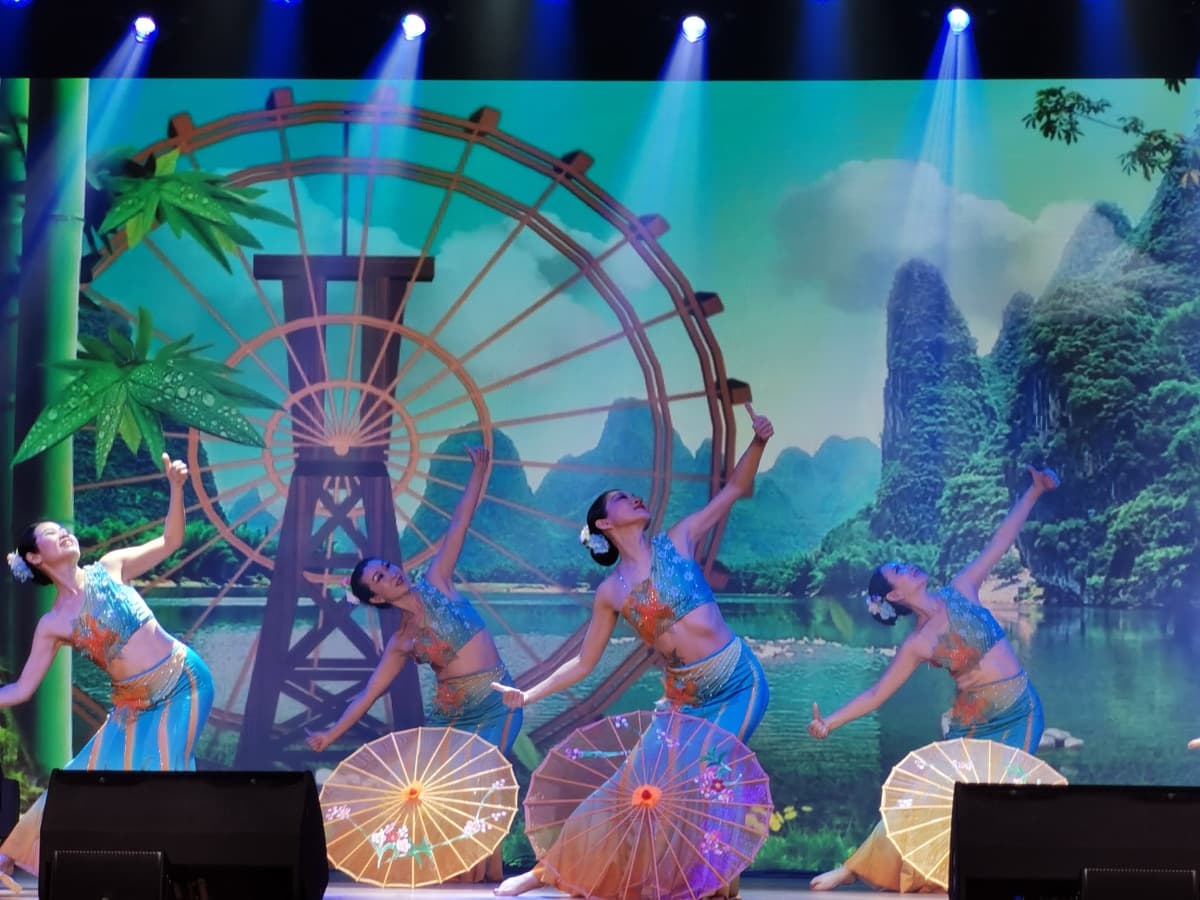
On certain nights, a Singapore street stops being a street. The barriers go up, the floodlights come on, and a river of colour begins to move — drums, ribbons, silk fans catching the light, float after float, community after community. Somewhere in that current, on a stage the size of a small field, a group of dancers finds its mark, breathes, and begins. From the crowd they look like seasoned performers. Up close they are something quieter and, we think, more remarkable: ordinary adults — people with desks and commutes and inboxes — who decided, some time earlier, to learn a dance well enough to carry it in front of a whole city.
That is the honest shape of our story on Singapore's public stages. This is not a highlight reel, and it is not a claim to be anyone's foremost troupe. It is simply an account of a few nights that mattered to us — the road to Chingay, and to the River Hong Bao riverside — told the way we lived them: with a lot of rehearsal, a little nervousness, and a deep sense of privilege at being allowed to take part at all.
Before the stage: the ordinary evenings
Every large performance is mostly invisible. What the audience sees is three or four minutes of light and motion; what comes before is a long stretch of unremarkable weeknights. A studio floor after work. Music started and stopped and started again. The same eight counts, repeated until the arms remember what the mind keeps forgetting. Adults arriving straight from the office, changing quickly, apologising for being tired, and then somehow finding, once the music began, that the tiredness lifted for an hour and a half.
None of the people who eventually stood on those festival stages began as professionals. They were beginners and returning dancers and working adults who had simply kept turning up. A public stage does not lower its standards for you, so the only honest way to meet it is through the weeks and months of preparation any such performance asks for — patient, gradual, done together. That preparation is the real work, and it is also, quietly, the reason the nights meant so much. You do not carry a dance in front of a nation by accident. You carry it because a room full of ordinary people chose, week after week, to be a little braver than the week before.
Chingay: many communities, one stage
In 2020, a 35-member team from YUE Dance Studio took the Chingay stage. Writing that sentence still feels slightly unreal to us.
Chingay is not a Chinese festival, and that is precisely what makes it the right stage to begin this story. It is Singapore's great multicultural street parade — Malay, Indian, Eurasian, Chinese and countless other communities sharing a single avenue of light, each bringing its own colour and rhythm to a night that belongs to all of them. To dance Chinese classical and folk forms there is not to represent Singapore; it is to add one voice to an enormous chorus, and to stand shoulder to shoulder with dozens of other traditions doing exactly the same thing. That sense of being one voice among many is, honestly, the part we remember most warmly — more than any applause.
The performance was later featured by The Straits Times and shared by then-Prime Minister Lee Hsien Loong on social media. We mention it once, and then set it gently down, because the recognition was never the point. It was a kind and unexpected grace note. What we carry from that night is smaller and more human: the backstage hush before the cue, thirty-five people breathing in time, and the strange, steadying knowledge that everyone around you had walked the same long road of rehearsals to get there. For a group of adult learners, being part of Chinese dance performances in Singapore's most public celebration was not a trophy. It was a homecoming into the country's shared cultural life.
River Hong Bao: dancing in the new year
If Chingay is Singapore's parade, River Hong Bao is its Lunar New Year heartbeat — one of the most beloved festivals of the season, a riverside of lanterns and families and food and light. In 2021, we had the privilege of dancing there, and the night remains one of our fondest as a studio.
We brought three pieces to the River Hong Bao stage: 《傣家竹雨情》, a Dai-inspired dance of bamboo and gentle rain; 《藏音》, drawn from Tibetan movement and voice; and 《阿里情》, with its lilt of the mountains. Three regions, three characters, three moods — folk and ethnic Chinese dance in its full range of colour, offered to a crowd out celebrating the turn of the year. There is a particular joy in dancing at a festival rather than a theatre: no one is sitting in reverent silence, children are pointing, families are milling, the new year is arriving all around you, and your dance is simply part of the happiness in the air.
That evening, the studio received the festival's Best Live Performance Award. We name it here the way we experienced it — folded inside a night that was already complete without it. The award was generous; the real gift was the dancing itself, and the faces in the crowd who, for a few minutes, watched a handful of adults from a small dance studio bring River Hong Bao a little more colour.
What the recognition really meant
Our earliest encouragement on this road came before either festival. In 2018, at the Singapore Golden Lion Cup — the 26th Music and Dance Competition, supported by 958 City Channel, Lianhe Zaobao and the Chinese Embassy — the studio was given a Gold Award. We were young then, barely a year old, and it would have been easy to read too much into it.
We have tried, ever since, to hold awards the right way round. Recognition like the Golden Lion Cup Gold Award, or River Hong Bao's Best Live Performance Award, is not a measure of how good we are; it is a door held open by others in Singapore's cultural community, an invitation to keep showing up and keep growing. We attribute the credit outward — to the organisers who make these stages, to the audiences who fill them, to the wider dance community that welcomed a young adult studio into its midst. Inside the studio, the medals live in a drawer. The thing we actually keep is the memory of the people who danced. You can read a little of what these experiences meant in our students' own voices, and see the fuller record of where we have danced on our performances page.
Why an adult would ever step onto such a stage
It is a fair question. Most of the people who performed at Chingay and River Hong Bao did not grow up dancing. They came to it as adults, often assuming the door to big stages had closed decades ago, if it had ever been open at all.
What we have learned, over these years, is that the stage is far more welcoming than people fear — and that stepping onto it changes something in a person. An adult who has spent months learning a piece well enough to perform it publicly walks a little differently afterwards. Not with vanity, but with a quiet new confidence: I did not think I could do that, and I did. That is available to far more people than believe it. The dances we brought to these festivals are the same forms taught in our ordinary weekly classes — Chinese classical, folk and ethnic dance — guided by instructors who prepare beginners and returning dancers for exactly this kind of growth, at whatever pace a body needs. You do not audition into the culture. You begin, and it makes room for you.
Not every student will stand at Chingay, and no one has to. But the same practice that carries a dancer to a festival stage — the patient repetition, the community of a shared floor, the small weekly courage — is the practice that makes an ordinary Tuesday evening quietly meaningful. The performances are the visible peaks. The real terrain is the everyday.
Beginning your own thread
We tell this story humbly, because it was never only ours. It belongs to everyone who shared those stages with us, to the festivals that made room for a young studio, and to a Singapore generous enough to let many communities dance on the same night. If there is one thing we hope you take from it, it is this: the people on those stages were not a special breed. They were adults who started, kept turning up, and let a dance carry them somewhere they never expected to stand.
If any of this stirs something in you, come and feel the tradition from the inside — no experience required, and no stage expected of you. A single trial class is a gentle way to begin: any style, $38 for a 1.5-hour session. Have a look at the weekly schedule, and when it feels right, get in touch. Every dancer who has ever stood in festival light once stood, exactly like you, at the edge of a first class — wondering, and then beginning.
Come find the beauty in dance
Any class, $38 for a 1.5-hour session. Come see how it feels.
Book a Trial