

Should Adults Perform? Why the Stage Is Worth It
27 February 2026
You are in the changing room after class, half-listening while a couple of classmates talk about the recital — who is in which piece, when rehearsals start, what they might wear. For a moment you picture yourself out there under the lights, and something in you leans toward it, quietly, before a louder voice cuts in. The stage is for children in recital costumes and for professionals who trained since they were six. Not for someone like me. You took up dance at thirty-eight, or forty-five, or fifty-one. You come to move, to feel good, to let the week fall away — not to be watched by a room full of strangers. You put the thought away and reach for your bag.
That hesitation is worth taking seriously before we do anything else with it. The nerves are real, they are reasonable, and they are almost universal among adults who dance. Nobody is going to tell you they are silly. But the conclusion you drew from them — that the stage belongs to other people — deserves a second look. Because the honest answer to should adults perform is not a rule handed down from above. It is a personal invitation, one you are allowed to accept, decline, or leave open for another year.
Where the "stage is for kids or pros" idea comes from
The belief has a source, and it is worth naming so it loosens its grip. Most of us formed our picture of "performing" from two images: the childhood recital, all tulle and nervous waving to parents in the third row; and the professional, lit from above on a grand stage, the product of a decade of full-time training. Between those two poles, the adult who simply loves to dance seems to have no place — too old for the first, too far from the second.
But that gap is an illusion of framing, not a fact about stages. Performing is not a qualification you earn by starting young or by turning professional. It is something a person chooses to do because working toward it changes them. The child at the recital and the professional under the lights are the two most visible kinds of performer, which is exactly why they crowd out everyone in between. The adult amateur — dancing for the love of it, stepping onto a stage a handful of times in a life — has always existed. You just rarely see them, because their moment is quiet and local and over in four minutes. That does not make it less real, or less worth having.
The case for performing
Set the fear aside for a paragraph and consider what performing actually gives the person who does it. Not fame, not applause for its own sake — something more useful and more lasting.
A deadline sharpens everything. There is a particular kind of focus that only arrives when a date is circled on the calendar. A phrase you have half-learned for weeks suddenly demands to be finished. The transition you always fudge, you finally drill until it is clean. Working toward a performance concentrates your practice in a way that no open-ended "I'll get to it" ever manages. Many adults find they improve more in the weeks before a recital than in the months before they signed up for one. The stage is not the reward at the end of the work; it is the reason the work gets done.
You build something with other people. Class is companionable, but a piece rehearsed together over weeks is a different bond entirely. You learn each other's timing, cover for each other's wobbles, laugh at the same impossible count until it finally clicks. Standing in the wings before you go on — hearts thudding in unison, someone squeezing your hand — is a closeness that ordinary adult life, with its scheduled coffees and polite distances, rarely offers. People come for the dancing and stay for the castmates.
You do the scary thing, once in a while, on purpose. Adult life is arranged, sensibly, to avoid unnecessary fear. We get good at staying within what we can already do. A performance is a rare, voluntary exception — a small, contained encounter with your own nerves that you walk into by choice and walk out of having survived. The pride on the other side is not vanity. It is the specific, hard-won satisfaction of having been afraid and gone anyway. It tends to outlast the memory of any wrong step, and it has a way of following you off the stage into the rest of your life.
None of this requires you to be good, in the competitive sense. It requires you to be willing. That is a much lower bar, and a much more interesting one.
Entirely optional — and that is the whole point
Here is the part that should lower your shoulders: at YUE, performing is a choice, never an expectation. Nobody is graded on their willingness to be seen. The great majority of what happens here is simply class — the weekly hour and a half of moving well, learning a little more, and going home lighter. You can dance with us for years and never set foot on a stage, and you will have missed nothing you were required to have. The schedule is built around the ordinary, restorative rhythm of showing up to class, not around auditions.
That optionality is not a small footnote. It is precisely what makes the invitation trustworthy. Because you are under no pressure to perform, the decision to do it stays yours — made from curiosity or courage, not obligation. And when there is no penalty for saying "not this year," it becomes far easier to one day say "actually, yes."
Our recital: a gentle first stage
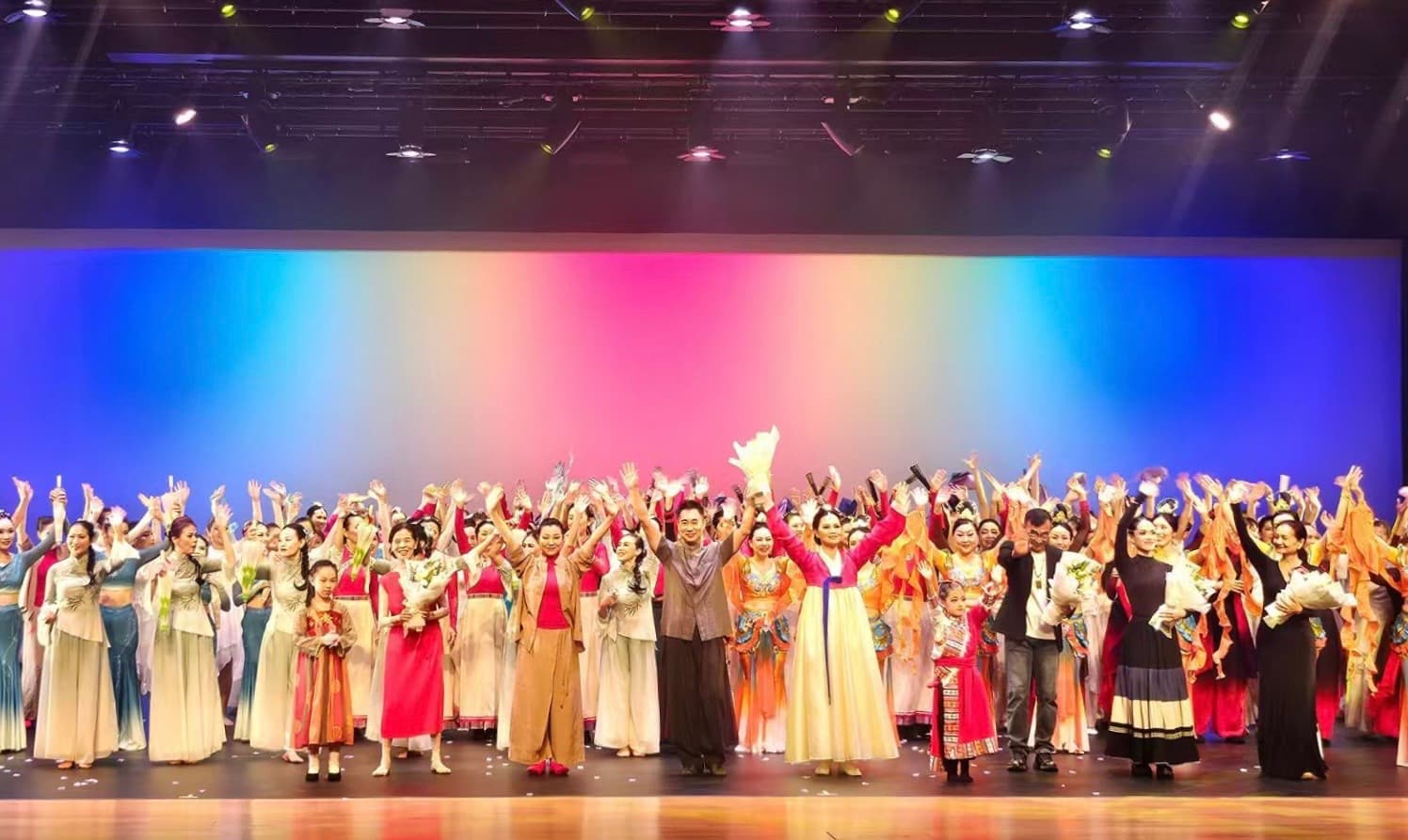
If and when you do feel the pull, there is a natural place to start. Our recital, YUE Dance Rising 《悦舞飞扬》, is the studio's flagship gathering — the occasion the whole community shapes itself toward. The first edition, YUE Dance Rising I, marked our fifth anniversary in 2023; YUE Dance Rising II followed in 2025 for our seventh, a showcase of original works celebrating years of artistry and community. It is a supportive room, not a competitive one: an audience of fellow students, friends, and families who are on your side before you take a single step.
An adult dance recital of this kind is about the most forgiving entry point to performing that exists. The scale is human. The stakes are warm. You are surrounded by people at every level, many of them just as new to the lights as you are. It is a long way from the intimidating image of the professional stage — and that distance is the point.
It helps, too, to know the studio is no stranger to real stages. Over the years our dancers have performed at Singapore's beloved River Hong Bao, where the work earned a Best Live Performance Award, and on the grand scale of the Chingay Parade. You can browse the fuller record of where this community has danced on our performances page. None of that history is a bar you must clear. It is simply evidence that a serious, generous performing culture lives here — one that has room for a first-timer standing nervously in the wings.
Overcoming stage fright: normal, and manageable
Let us be honest rather than breezy: stage fright is real, and pretending otherwise helps no one. The racing heart, the dry mouth, the certainty in the final minute before you go on that you have forgotten everything — seasoned performers feel all of it too. They have simply learned that the feeling is not a verdict on how the next four minutes will go. It is just adrenaline, arriving on schedule, doing its ancient and slightly overenthusiastic job.
For adults, overcoming stage fright is less about eliminating the nerves than about changing your relationship to them. A few things genuinely help:
- Preparation is the best sedative. Fear thrives on doubt. When the choreography lives in your body from weeks of rehearsal, there is far less room for the mind to spiral. You will not be relying on memory under the lights; you will be trusting a habit.
- Breath is a tool you always have. A few slow, deliberate exhales in the wings will steady a racing heart more reliably than any pep talk. The nerves ride on shallow breathing; lengthen the breath and they lose some of their grip.
- You are never out there alone. In a group piece, the people beside you are feeling exactly what you are feeling, and moving with you through every count. Fright shared is fright halved.
- The audience is on your side. They did not come to catch you out. They came to be moved, and they are quietly delighted when someone who was frightened does it anyway.
Nerves, handled this way, stop being a reason not to perform. They become part of the experience — the price of admission to the pride that comes after.
You do not have to decide today
So — should you perform? Perhaps not this term. Perhaps not this year. The invitation does not expire, and there is no wrong answer. But notice, next time you catch yourself picturing the stage and reaching for your bag, that the leaning-toward-it came first, and the not for me came second. The first instinct is often the truer one.
Everything here begins with class, long before it ever touches a stage. Come and try one — any style, $38 for a 1.5-hour session — and simply see how it feels to move. There is no recital at the end of a trial, only an hour and a half that is entirely yours. When it feels right, get in touch. The stage, if you ever want it, will be there — patient, warm, and more within reach than the louder voice would have you believe.
Come find the beauty in dance
Any class, $38 for a 1.5-hour session. Come see how it feels.
Book a Trial