

What Is Chinese Classical Dance? A Beginner's Guide to 古典舞
26 June 2026
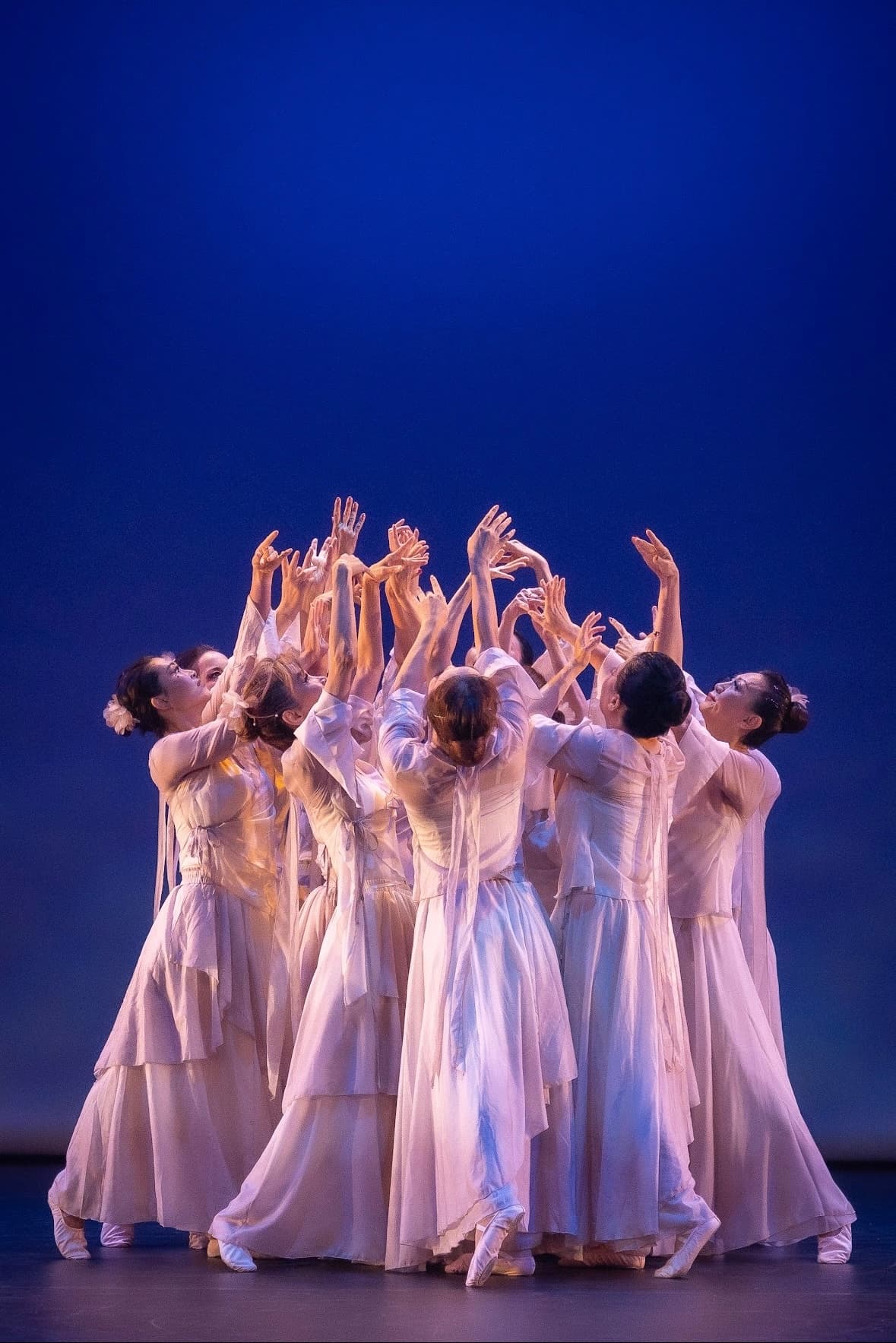
Picture a single arm beginning to rise. It does not shoot straight up. The wrist leads first, soft as a question; the elbow follows a beat later; the hand blooms open at the very top of an exhale. And then, instead of stopping there, the whole line changes its mind — it curves, spirals back on itself, and the torso tilts a few degrees off its vertical, so that for one suspended moment the body reads like a brushstroke drawn in the air. Nothing about it is sharp. Nothing about it is straight. And yet it is precise.
That one gesture holds almost everything that makes Chinese classical dance what it is. By the end of this guide you'll know what you're looking at when you see it — and, just as importantly, why it feels the way it feels to do.
So, what is Chinese classical dance?
Chinese classical dance — 古典舞, gǔdiǎn wǔ — is best understood not as a fixed set of poses but as a way of moving. It is a codified art form: a shared vocabulary of shapes, pathways, and principles that dancers train in the way musicians train in scales. What it expresses is graceful, lyrical, often quietly dramatic; how it is built is surprisingly systematic.
It helps to be honest about its age. You'll sometimes hear that classical dance is thousands of years old and unchanged. The truer picture: it draws on very old sources — traditional opera, martial arts, the aesthetics of classical painting and court life — but the form we study today was shaped relatively recently, distilled by teachers and choreographers over the modern era into a coherent stage language. Ancient roots, modern grammar.
Two quick distinctions, since the terms travel together:
- Folk and ethnic dance (民族舞) celebrates the specific character of a region or people — the shoulder shimmer of a Mongolian dance, the swaying grace of a Dai water-village piece. It's rooted in place and community.
- Ballet shares classical dance's discipline and love of line, but reaches upward and outward, toward lightness and elevation. Chinese classical dance tends to curve inward and around, drawing the eye along a continuous, unbroken thread.
Classical dance is its own thing: the distilled, stage-ready core of a much larger Chinese movement tradition.
Where it comes from: opera, martial arts, and an old idea of beauty
You don't need any of this history to walk into your first class. But knowing it is why the dance rewards patience — every principle you'll practise has a lineage.
From the opera stage (戏曲)
Traditional Chinese opera is theatre in which a lifted eyebrow, a turned wrist, or the flick of a long silk sleeve carries meaning. Classical dance inherited its stylised gesture and, above all, its coordination of hand and eye — the idea that the gaze leads the movement, that where you look shapes how a shape reads. This is where the dance gets its storytelling quality: even a wordless phrase seems to be saying something.
From the martial arts hall (武术)
Watch a martial artist hold a stance and you'll see it: weight sunk low, spine long, a stillness that is anything but slack. Classical dance borrows this rootedness and control — the coiled-then-released quality where energy gathers quietly before it travels. It's why the form can be soft without being weak, and why a slow movement feels as charged as a fast one.
From ink, scroll, and court
The last ingredient isn't a technique at all — it's a taste. Chinese classical painting and poetry prize the curved, flowing line, the balance of emptiness and fullness, the sense of a single continuous energy running through a composition. Dance took that ideal into three dimensions. When your arm carves an arc through the air, you are, in a real sense, doing calligraphy with your whole body.
The heart of it: 身韵 (body rhythm)
If there is one word that separates classical dance from simply making the right shapes, it is 身韵 — shēn yùn, usually translated as "body rhythm." It is what turns a correct posture into living dance.
身韵 is built from two ideas held together:
- 身法 (shēn fǎ) — how the body moves: the mechanics, the pathways, the way one part leads and the rest follow.
- 韵律 (yùn lǜ) — the inner rhythm and flow: the musicality underneath the movement, the reason a phrase breathes rather than clicks from pose to pose.
The governing principle is that movement starts from the centre and radiates outward. A gesture doesn't originate in the hand; it begins deep in the core — around the 丹田 (dāntián), the low centre of gravity just below the navel — and travels through the spine, the shoulder, the elbow, and only then reaches the fingertips. That's why, in the opening image, the wrist could lead while the whole body was quietly involved.
If that sounds like a lot, here is the reassurance every beginner needs: nobody expects 身韵 on day one. It is taught progressively, layer by layer, over months and years. You start by learning where your centre is. The flow comes later, and it comes to everyone who keeps showing up.
Breath is the engine: 气息
Here is the quiet secret that surprises most newcomers: in classical dance, breath drives movement, not the other way around. You rise on an inhale and settle on an exhale. The breath (气息, qì xī) is the engine; the limbs simply ride it.
If you've ever done yoga or tai chi, this will feel familiar — that same sense of movement and breath braided together, so that the body seems to expand and gather like something alive. It's a useful comparison to hold onto, because it demystifies what can otherwise look impossibly refined: at its foundation, this is a breath-led practice.
Learn to move with your breath, and half of the grace takes care of itself.
This is also, quietly, why so many adults fall for it. A class becomes genuinely meditative — thirty or sixty minutes in which your attention narrows to breath, weight, and line, and the noise of the day recedes. It's physical, yes. But it quiets the mind just as much.
Why nothing moves in a straight line: 圆 · 曲 · 拧 · 倾
Remember that opening arm that curved and spiralled instead of stopping? Four principles were at work, and once you can name them you'll see them everywhere in the form.
- 圆 (yuán) — roundness. The dance lives in circles and arcs. Arms trace ellipses; the whole body moves through curved pathways rather than straight lines. Even a change of direction is a small orbit.
- 曲 (qū) — curve. Where a line could be flat, it bends. Knees, wrists, spine — there is almost always a gentle curve holding softness in the shape.
- 拧 (nǐng) — twist, or spiral. The torso and limbs turn against one another: shoulders opening one way while the hips anchor another, so the body coils. This is what gives classical dance its three-dimensional richness — you're never looking at a flat picture.
- 倾 (qīng) — tilt, or lean. The body sits slightly off true vertical. That small imbalance is deliberate; it creates tension, dynamism, and a great deal of the form's elegance.
Put them together — round, curved, spiralled, tilted — and you have the answer to the question the opening scene posed. That is what makes a shape look unmistakably Chinese: it never travels in a straight line, and it never quite comes to rest.
What an adult beginner class actually works on
If you're imagining being asked to spin or leap in week one, let that worry go. A well-taught beginner class builds from the ground up, and it is paced for adult bodies. In the early weeks you can expect to work on:
- Posture and alignment — finding a long spine and a grounded stance, the foundation everything else sits on.
- Basic hand shapes — including the 兰花指 (lán huā zhǐ), the soft "orchid finger," a gentle, blossom-like hand that appears constantly in the form.
- Simple arm pathways — those first curved lines, taught slowly enough to actually feel.
- Coordinating breath with motion — the rise-and-settle we described above, practised until it's second nature.
- Gentle flexibility and core strength — built up patiently, never forced.
You do not need to have danced as a child. You do not need to arrive flexible — flexibility is something the practice gives you, not a ticket you need to enter. Complete beginners are not just welcome; they're the point.
At YUE Dance Studio, classical dance is led by Angel Peng (彭若丹), a graduate of the Dance Department of the Shenyang Music Conservatory with over a decade of teaching behind her. Her approach centres on cultivating a genuine feel for movement and unlocking each student's own expression through gentle, focused guidance — exactly the temperament a first classical class calls for. You can read more about her and the teaching team on our instructors page. (Current class times and offerings are on the schedule.)
Why it's so rewarding for adults
The obvious rewards show up first: you move more gracefully, and that poise quietly follows you off the dance floor — into how you stand, how you carry yourself, how you enter a room. But the deeper rewards are the ones adults tend to stay for.
- A mindful counterweight. In a life measured out in screens and notifications, a breath-led, unhurried practice is a genuine reset. You leave a class more collected than you came in.
- A cultural thread. For many in multicultural Singapore, classical dance is a way back to heritage — not through a textbook, but through the body. There's a particular satisfaction in feeling an aesthetic you may have only ever admired from the audience.
- Community, and the stage if you want it. You practise alongside other adults who chose the same thing you did. And for those who catch the bug, there are moments to perform: our dancers have taken the Chingay stage (later featured in the Straits Times), earned a Gold Award at the Singapore Golden Lion Cup, performed at River Hong Bao, and gathered for the studio's own 悦舞飞扬 (YUE Dance Rising) anniversary recitals. Those stages are open to students who want them, and entirely optional for those who simply want to dance. You can see some of that work on our performances page, and hear from adult students at voices.
How to try it
Reading about classical dance only takes you so far. The curve, the breath, the spiral — they have to be felt, in a single class where your own arm makes that first unhurried arc through the air.
If you're curious how it feels, you can try any class — including Chinese classical dance — for $38 for a 1.5-hour session. It's a low-pressure way to meet the teacher, borrow the breath, and let your body discover the line for itself. When you're ready, get in touch to book your trial, or browse the full schedule to find a time that fits. However you begin, begin gently — that, after all, is the whole idea.
Come find the beauty in dance
Any class, $38 for a 1.5-hour session. Come see how it feels.
Book a Trial